


Skip to content

Automated Price Sensitivity Meter (PSM)

Price Sensitivity Meter (also known as Van Westendorp method) is used to investigate different price perceptions and the price limits consumer's place in relation to a specific product or service.

quantilope's Price Sensitivity Meter is fully automated, allowing users to drag and drop the method into their survey instantly and watch results in real-time.

Man doing research on iPad

Benefits of quantilope's automated PSM

Benefits of PSM icon 1

Follows a natural demand curve for valid sales estimation

Benefits of PSM icon 2

Leverages automated chart options, removing the need for intense manual calculations

Benefits of PSM icon 3

Clearly differentiates premium items from budget/value options

Applications of quantilope's automated PSM 

What is the optimal price for a new product?

PSM chart screenshot

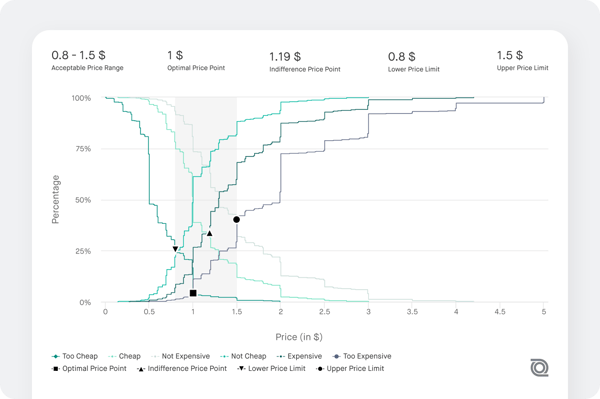
$1 is the optimal price for the product, while $1.19 is the category price that the consumers perceive as normal.

What price point will attract the most amount of consumers?

PSM chart screenshot

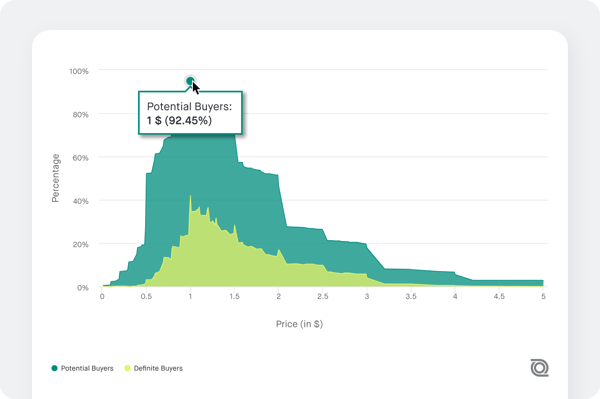
$1 will attract the largest proportion of possible and certain buyers.

For a company that moves as fast as we do, it’s essential to generate insights at equal momentum. quantilope enables us to do exactly that.”

- Sandra Schlicht, Business Insights Manager

Oatly logo


Frequently Asked Questions (FAQs):

How do you measure price sensitivity?

Price sensitivity is measured using price elasticity of demand, which tracks how consumer demand shifts when prices change—products with high elasticity see major demand changes from small price shifts, while inelastic products maintain steady demand despite price changes.

quantilope automates this measurement so you can focus on the results, not the manual and complex calculations. 

What is an example of price sensitivity?

Luxury items typically show low price sensitivity because brand prestige keeps sales stable even when prices increase, while everyday groceries demonstrate high price sensitivity as shoppers quickly switch to cheaper alternatives when prices rise.


What are the indicators of price sensitivity?

Price sensitivity indicators include brand value, competition level, product lifecycle stage, purchase frequency, and competitor intensity. These factors feed into algorithms that calculate how responsive consumers are to price changes for a specific product.


What are the 4 questions for pricing?

The Van Westendorp Price Sensitivity Meter uses four pricing questions:

  1. At what price is the product too expensive to buy

  2. What price is it expensive but worth considering

  3. At what price is it a bargain?

  4. At what price is it too cheap that quality becomes questionable.


How does Price Sensitivity Meter differ from other pricing methods?

Unlike pricing methods like Conjoint Analysis that force trade-offs between features, the Price Sensitivity Meter (also known as Van Westendorp) focuses solely on consumer psychological price points using four open-ended questions. It identifies a specific "range of acceptable prices" by finding the intersection of perceived value and "too expensive" or "too cheap" thresholds.

What is the "Optimal Price Point" and "Indifference Price Point" in PSM?

The Optimal Price Point occurs at the intersection where the number of people who think a product is "Too Cheap" equals the number who think it is "Too Expensive." This point theoretically minimizes resistance, as it balances the risk of losing customers due to high cost against losing them due to perceived low quality.

The Indifference Price Point is where the "Cheap" and "Expensive" curves cross, representing the median price people expect to pay. Most consumers at this price point don't have a strong opinion on whether the product is a deal or a splurge, making it a safe but potentially low-margin benchmark.

Request an automated PSM demo